






















Disclaimer: This is a compensated campaign in collaboration with Allstate Foundation® and Latina Bloggers Connect.
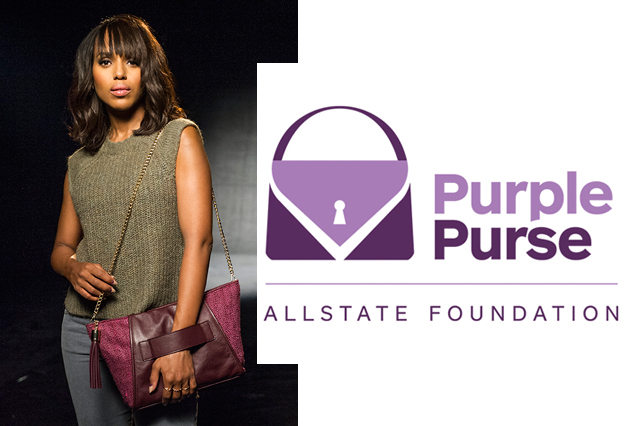
[dropcap]W[/dropcap]ith all the recent high-profile coverage of domestic violence in the news, we at Modern Chic feel it is imperative that we do our part to expose the glaring side of domestic violence, and help ensure no one stays a victim or becomes one in the future. We have teamed up with Allstate Foundation and Latina Bloggers Connect to collaborate on the Allstate Foundation Purple Purse campaign to get the dialogue going on and encourage all of us to take part in the Purple Purse Challenge.
The Allstate Foundation has created this challenge to raise funds for 145 nonprofit community partners across the country that provide critical financial empowerment services for domestic violence survivors. This year, Emmy-nominated actress and domestic violence activist Kerry Washington is serving as the Purple Purse ambassador to help raise awareness for the cause. She has also designed limited edition purple purse to inspire women to reclaim their financial independence.
Why the Purple Purse symbol?
The Purple Purse has become the Foundation’s national symbol for domestic violence and financial abuse because it represents the center of a woman’s financial domain and purple is the national color of domestic violence awareness. But more importantly, the symbol encourages us to openly talk about this important issue—even making it fashionable to do so.
Domestic violence affects 1 in 4 women. In fact, an estimated 1.5 million women and 835,000 men are victims of rape and/or physical assaulted by an intimate partner each year, according to the National Institute of Justice and the Centers for Disease Control and Prevention. Domestic violence is not limited to gender, race, sexual orientation or age. Anyone can potentially become a victim
What many of us do not consider is the financial abuse that goes hand in hand with domestic violence.
Financial abuse can often make an abused victim feel like they are under lock and key—their power swiftly taken away from them as they do not have the financial means to escape their destructive relationship. Unfortunately, many victims are left to deal with exuberant debt run up by their abusive partners, forcing them to take on the responsibility. This can be an even more financial burden for those victims with children. This is often one of the main reasons why domestic violence survivors stay or return to an abusive relationship.
Despite the staggering statistical figures, society continues to turn a blind eye to this issue. It takes high profile domestic cases like that of former Baltimore Ravens running back Ray Rice to get the media and public’s attention on the vicious violence and abuse women and men alike face.
For those of us who have healthy relationships and have never experienced domestic violence first hand, we can find it almost incomprehensible that victims would continue with these abusive relationships. However, the reality is not always as clear-cut as we hoped.
The strength to leave an abusive partner can be incredibly hard for a victim to do. The physical abuse has not only left bruises on their body but has scarred them so emotionally to the point that they start to believe they deserve all the constant name-calling and abuse each day. The other issue is where to turn too. Police enforcement should register number one of the list, but for some victims contacting the cops and reporting instances of domestic abuse is not always an available option.
Fear and shame can make a victim feel as if they have no one fighting for their side, willing to go in and protect them from this destructive relationship and financial dependency. Sometimes involving others in the dispute like family members or authorities can have dire reverse effects—sparking more abuse or merely serving as a fragile buffer for a short period of time. And for those victims who are able to successfully escape their abusers, they face a long healing process ahead.
How can we help?
Helping to stop domestic violence starts from the bottom up. The first step is to create an open dialogue with family members, friends, classmates, and others to talk about domestic abuse and addressing the negative impacts it can have on a person. If we stop treating this as a taboo subject and bringing more focus on it, we can help educate others on picking up on the early signs of abuse, whether it’s in their own personal lives or someone they know. While domestic violence cannot be eradicated overnight, our unwillingness to make abuse okay for anyone can pave the way to a better, healthier future for women and men.
If you know someone directly affected by this, the time for him or her to do something about it is now. Let them know this is not okay and will never be okay. Reach out to them and take their hand to seek the help they need. Love them unconditionally so they know they are will no longer be victims but victors.
Despite the number of victims of domestic violence, there are courageous survivors who continue to break free from long-time abuse. Their act of bravery is a testament to a better life out there, where fear, neglect, and violence do not come to play.
But for those affected by domestic violence, know that your own story is the ultimate success. The mountain ahead may look impossible to climb right now, but you will conquer it.
Hold this mantra to your heart: You are stronger than you look and more beautiful then you know.
We encourage you to visit PurplePurse.com to read more on this campaign and read the important tips and tools to help recognize domestic violence and financial abuse. Supporters can also make donations to the cause now through October 3rd.
Let us commit from this day on that we will work together to never let anyone be a victim again.
If you or someone you know needs immediate help, call the National Domestic Violence Hotline at 1-800-799-SAFE (7233) or TTY 1-800-787-3224. Help is here for you.